
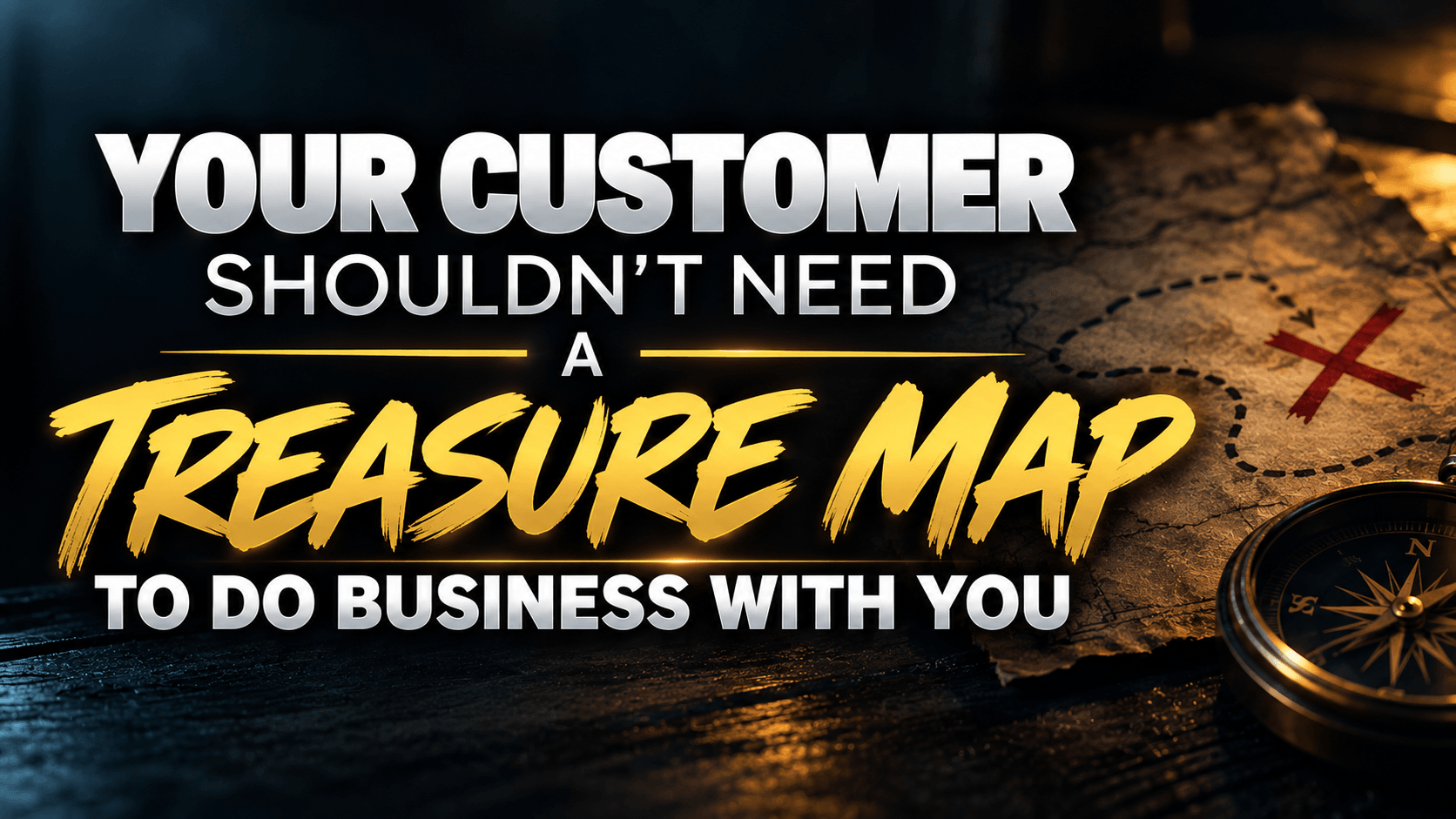
Your Customer Shouldn't Need a Treasure Map to Do Business With You
The customer experience test that reveals where buyers get lost after they sign up
Congratulations! You just made a sale.
Your new customer is excited. They're ready to jump in, learn something and get their money's worth.
Then they get their first assignment.
Find the welcome email.
Easy enough. Except it's hiding in Promotions, right between a pizza coupon and an offer to extend their car warranty.
Found it!
Now they need to create a password.
Wait. That's a different password from the one they just created?
Wonderful. We're off to a great start.
The course is in one place. The community is somewhere else. The bonus materials are hiding behind another link.
And customer support?
Apparently, that's the final boss.
Welcome to the Customer Treasure Hunt!
You Know Where Everything Is. They Don't.
Here's the funny thing.
Most business owners aren't trying to make life difficult for their customers.
We've simply spent so much time building our businesses that we know every shortcut, login, and secret passage.
We know which email has the link.
We know where the bonuses live.
We even know which button looks broken but actually works if you click it twice.
Our customers?
They're standing at the entrance wondering where the front door went.
What's obvious to us isn't always obvious to someone arriving for the first time.
Confusion Has a Cost
A confusing customer experience doesn't always create a dramatic complaint.
Sometimes people just quietly disappear.
They buy the course but never find lesson one.
They join the membership but never participate.
They ask the same support question you've already answered seventeen times.
And somewhere along the way, the excitement they felt when purchasing starts fading.
That's the part worth paying attention to.
You worked hard to earn their trust.
Why make them work harder to enjoy what they purchased?
Take the Customer Treasure Map Test
Here's something you can do today, and it won't cost you a dime.
Pretend you've never heard of your business.
Seriously. Put on your imaginary customer hat.
Now walk through these five steps:
1. Find your offer. Is it immediately clear what you're selling and who it's for?
2. Sign up or purchase. Are the instructions simple, or does something feel confusing?
3. Access the purchase. Can you quickly find what you paid for without searching through emails?
4. Find the extras. Is it obvious where the community, bonuses, and other resources live?
5. Get help. If something goes wrong, can you find support without needing a detective license?
Here's the important part.
Don't just ask whether everything works.
Ask whether everything makes sense.
Every unnecessary click, confusing instruction, or missing connection is worth examining.
Better yet, ask someone unfamiliar with your business to try it.
Watch where they hesitate.
Those little moments can tell you more than another afternoon rearranging your homepage.
What If There Were One Clear Destination?
Now imagine a different experience.
Someone discovers your business, becomes a customer, and knows exactly where to go next.
One familiar place under your brand.
A place where they can find what they've purchased, continue learning, join conversations, and get help.
Not because every tool magically disappeared.
But because the customer no longer has to figure out how everything fits together.
That's the bigger idea behind building a business hub around the people you serve.
The tools aren't necessarily the problem.
It's what happens when your customers have to navigate the spaces between them.
And maybe the next big improvement in your business isn't another feature.
Maybe it's making the experience you already offer easier to enjoy.
One Last Thought
Your customers signed up for what you offer.
They didn't sign up for a scavenger hunt.
Want to see where your customers might be getting lost? Come share what you discover inside the Self Made Success Community we're comparing notes and simple ways to make the journey easier. |

AI Trends November 10, 2026: Marketing, Search & Agents
Four AI trends for entrepreneurs: Adobe and Supermetrics integrations, changing Google search traffic, and new research on agents and business automation.

How to Validate a Business Idea With AI Before You Build
Learn how to validate a business idea with AI, spot weak assumptions, and test real customer demand before spending time and money building your next offer.

What Customer Questions Reveal About Your Business | SMS
Learn how repeated customer questions reveal problems in your business. Try a simple 20-minute audit to improve the customer experience without new tools.

AI Trends November 3, 2026: Gemini, Shopify & Chrome
Explore four AI trends for small businesses: Gemini file editing, Shopify AI shopping, Google's connected apps, and Chrome's smarter autofill features.
0 Comments
Join the conversation
Be the first to comment
Share your thoughts above.