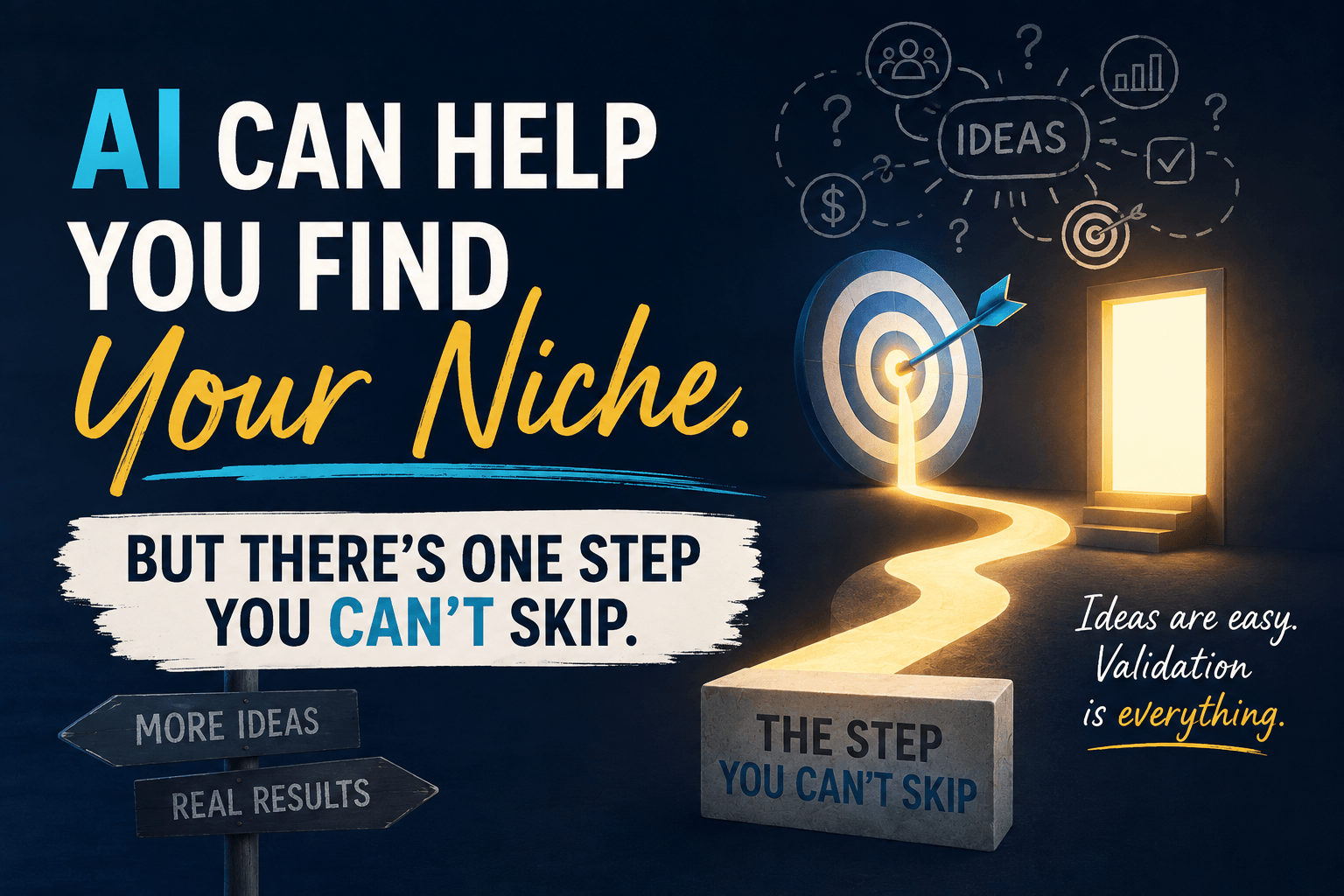
AI Can Help You Find Your Niche. But There's One Step You Can't Skip.
Generating ideas is easy. Figuring out which one deserves your time? That's the real challenge. Here's the step most entrepreneurs miss when using AI to find their niche.
AI can give me 50 business ideas before I've finished my first cup of coffee.
That's pretty amazing.
It's also potentially dangerous.
Because generating ideas isn't really the hard part anymore. Figuring out which idea deserves your time might be.
I've been thinking about this a lot lately. One thing I've noticed is how easy it is to get stuck in the research phase. You know the pattern. You have an idea. You ask AI to analyze it. AI gives you a beautifully formatted response about market size, competition levels, and revenue potential. You feel like you've accomplished something.
But have you?
Why Going Broad Feels Safe
Here's where I think a lot of entrepreneurs get tripped up. Going broad feels like the safer bet. If you can help everybody, theoretically you have more potential customers. More opportunities. Less risk of missing out on someone who might want what you're offering.
But there's a catch.
The broader your audience becomes, the harder it becomes to create a message that makes one specific person think: "That's exactly what I need."
Think about it this way. If you say "I help small business owners grow," you're technically talking to millions of people. But does any one of them hear that and immediately recognize themselves? Probably not.
Now try this: "I help local service businesses turn past customers into repeat business."
The second version doesn't mean nobody else can buy from you. It simply makes it easier for the right person to recognize themselves in what you're saying.
Where AI Becomes Really Useful
AI makes it incredibly easy to brainstorm business ideas. But I've found it's even more valuable as a thinking partner for working through the harder questions.
Instead of staring at a blank page wondering "What business should I start?" you can use AI to organize your thinking around things like your existing skills, your actual interests, potential audiences you might genuinely enjoy serving, the problems those people are dealing with, and whether there's a realistic way to generate revenue from solving those problems.
It's like having a really smart friend who asks good questions and doesn't let you off the hook with vague answers.
But there's a part of this that I think is easy to overlook.
The Trap
AI can make almost any business idea sound good. Seriously. Give it a mediocre concept and ask for an analysis and you'll get back something that sounds surprisingly promising. Market opportunities. Growth potential. Competitive advantages.
Here's the problem. A polished AI response can create a false sense that you've done market research when you've really only explored a hypothesis. AI can help you form the hypothesis. The market has to validate it.
I can ask AI whether an idea looks good all day long. Eventually, somebody in the real world has to agree.
The Step People Don't Want to Do
This is where it gets interesting. At some point, the idea has to leave the AI conversation. Someone has to test whether real people actually have the problem, care enough about solving it, respond to your message, show interest, take an action, and potentially pay for the solution.
Discovering an idea doesn't require committing the next five years of your life to it. Small tests can save enormous amounts of time. Finding out in two weeks that an idea doesn't have legs is much cheaper than spending two years trying to force it to work.
A rejected idea isn't necessarily failure. It's valuable information.
Entrepreneurs rarely suffer from a shortage of ideas. We suffer from believing every idea needs its own domain name. (Buying the domain is not technically market validation. I've checked. 😄)
The Four Questions
So what should you actually figure out before you go all-in on a niche? There are four big questions worth answering:
What could I realistically build around my skills and experience? Does a specific group of people have a problem worth solving? Is there room in the market for my approach? And most importantly, will real people actually respond to it?
Answering all four is much stronger than simply asking AI: "What profitable niche should I start?"
AI will happily give me 37 business ideas before breakfast. My problem is that I might want to build 12 of them.
Want to Try This?
I've been experimenting with a 4-step process for using AI to help discover and validate a niche, and I put the complete framework inside the Self Made Success Community. It includes the prompts for each stage, how to examine customer problems and demand, ways to evaluate competition and monetization, and how to build a simple real-world validation test.
If you've been sitting on a business idea, wondering which direction to take or trying to figure out who you really want to serve, this might be a fun one to work through.
Just remember... don't stop when AI tells you your idea looks good.
That's where the interesting part begins. |

AI Isn’t the Biggest Risk to Your Business. Fear Is.
AI regulation is evolving fast. Learn why fear may be a bigger business risk than AI itself and how skeptical entrepreneurs can keep moving.
5 AI Trends Happening This Week: October 6, 2026
AI trends this week for entrepreneurs: five practical AI business trends and tools worth watching for small business on October 6, 2026.
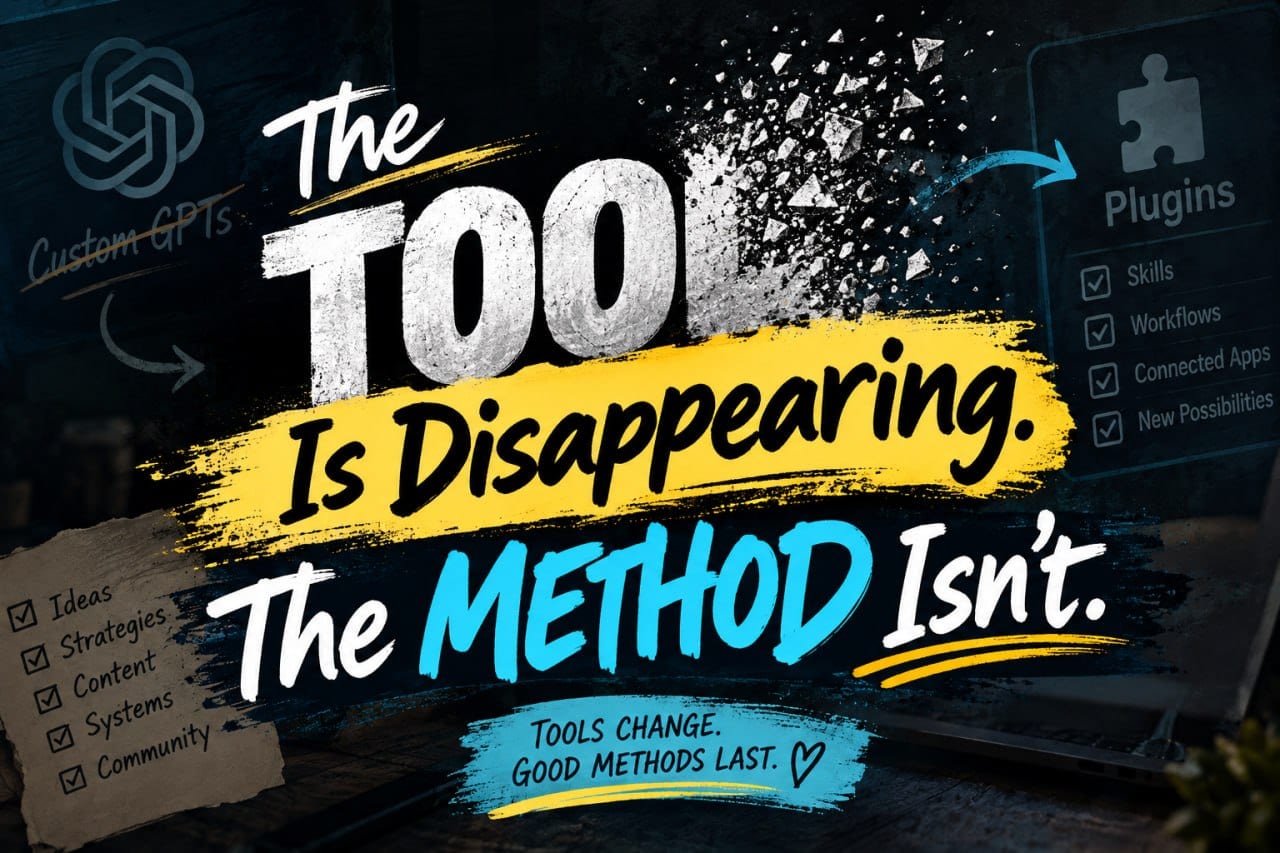
The Tool Is Disappearing. The Method Isn't.
OpenAI is retiring Custom GPTs on December 11, 2026. I built one for my Rapid Content Method course, and now I'm figuring out what comes next. The bigger question: Do you own the method, or only the container?
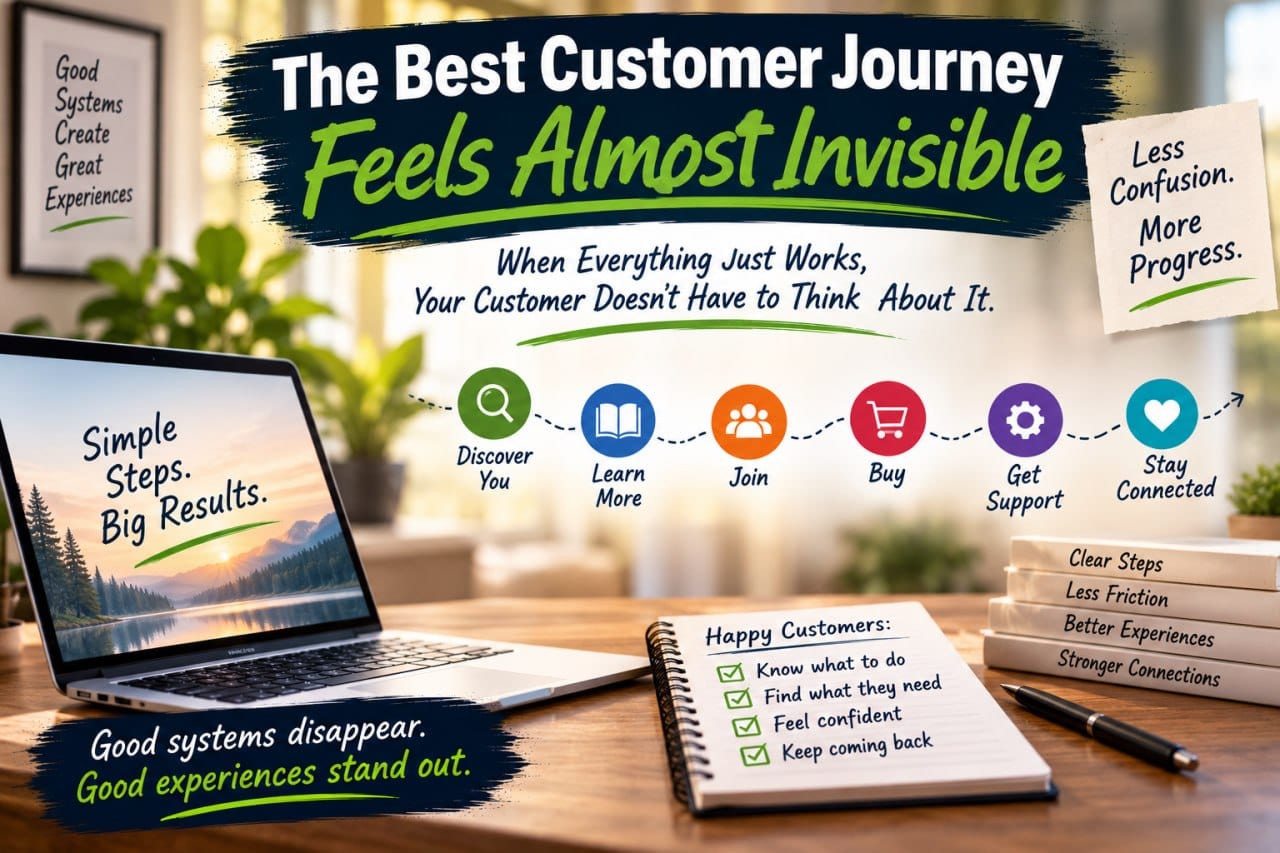
The Best Customer Journey Feels Almost Invisible
The best customer journey is one your customer barely notices. Learn how to find and fix friction points that make customers stop and ask, 'Where do I go now?'
0 Comments
Join the conversation
Be the first to comment
Share your thoughts above.