

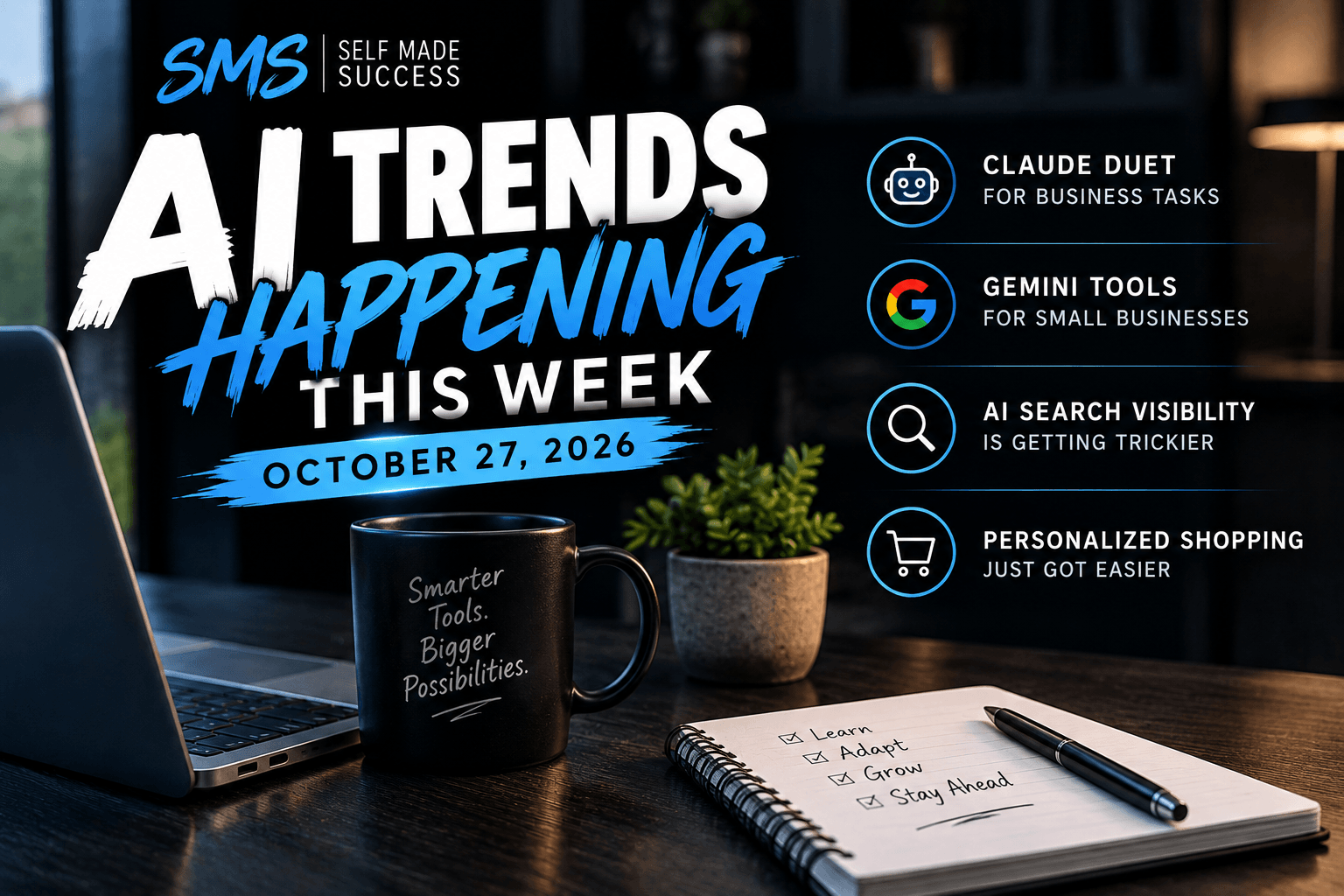
AI Trends Happening This Week: October 27, 2026
Claude Duet, Gemini business tools, AI search visibility, and smarter shopping quizzes
Just when you thought you'd figured out what AI was good for, it started asking for access to your calendar, offering to design your next promotion, and helping shoppers choose shampoo.
Meanwhile, the rules for showing up in AI search seem to change while you're making lunch.
Welcome to another week of business technology, where the exciting part is finding what actually helps and the less exciting part is reading the permissions screen.
Four developments from October 19 through 25 show where things may be heading. Here's what happened, what isn't settled yet, and what everyday entrepreneurs can take from it.
1. Anthropic Introduces Claude Duet for Business Tasks
On October 21, Anthropic unveiled Claude Duet, a separate AI agent experience designed to take a more active role in professional work. Reuters reported that it can surface a daily briefing, monitor connected apps for items needing attention, and assist with jobs ranging from meeting scheduling to financial forecasts.
That's different from a traditional chatbot. A chatbot usually waits for you to ask a question. An agent can follow a goal through several steps, sometimes using other connected services.
Imagine opening your workday to a short list of unanswered customer requests, upcoming meetings, and tasks that need a decision. That could be useful to a business owner who wears every hat in the building, including the one marked "IT department."
But here's the important availability detail: Reuters described Duet as a waitlisted research preview for US Claude Pro and Max subscribers, accessible through iOS, Android, and claude.ai. This is not the same as a tool already available to every business.
And access matters. A system that reads email, touches your calendar, or makes purchases needs clear limits. Anthropic says sensitive actions require user approval, while acknowledging the agent can still misjudge priorities.
What to watch: Before connecting an agent to business accounts, check exactly what it can see, what it can change, and when it must ask permission. Start with low-risk tasks and keep a person responsible for the final decision.
Read the Reuters report on Claude Duet.
2. Google Expands Gemini Tools for Small Businesses
Google's October 20 announcement, reported more widely on October 21, focused on a familiar small-business headache: doing marketing, managing information, and understanding numbers without a whole department behind you.
Google introduced a business-focused area within Gemini and described new ways to connect services such as Google Business Profile, Google Workspace, Canva, Shopify, and accounting-related tools.
One announced feature lets owners provide their website, colors, fonts, or brand materials so Gemini can create marketing visuals that follow a consistent style. Another is designed to turn spreadsheets, receipts, and purchase records into easier-to-read financial charts and interactive views.
Picture a local bakery preparing a seasonal promotion. Instead of starting every graphic from a blank page, the owner could use existing brand materials to guide a draft. Or a small retailer might use a visual summary to spot changes in expenses.
Those are potential uses, not a promise that every output will be accurate or instantly ready to publish. Brand graphics still need a human eye. Financial summaries need to be checked against the original records, especially before making money decisions.
Google said the new business page, skills, and connections would begin rolling out globally over the following days. So an announcement does not mean every account already has every feature.
What to watch: If the features appear in your account, test one simple, non-sensitive job first. Does the result save time? Does it fit your brand? Can you verify the numbers?
See Google's announcement of its Gemini small-business tools.
3. AI Search Visibility Is Becoming Harder to Predict
Remember when business owners mainly worried about where they appeared in a list of search results? Now an AI answer might recommend a business, mention it without a link, cite its website, or skip it entirely.
An October 20 analysis from Omnius examined how changes to AI models and search systems can shift which brands appear in generated answers. A model update, a different way of gathering web information, or even an interface change may affect what people see.
That makes AI visibility tricky to measure. Your business might show up for one question and disappear when the wording changes. One day's result isn't a permanent ranking.
This is where AEO, or Answer Engine Optimization, comes in. In plain English, it's the work of making your business information clear, useful, and easy for AI-powered answer systems to understand and potentially reference.
For a local contractor, that means accurate services, service areas, contact details, and helpful answers to real customer questions. For an online course creator, it might mean clear descriptions, useful guides, and consistent information across trusted places on the web.
HubSpot's AI Search Sensor tracks broader changes in AI mentions, citations, and referred traffic. It's useful context, but its industry-wide estimates are not a personal scorecard for your business.
What to watch: Check your important business facts, publish content that genuinely answers customer questions, and periodically test relevant searches across platforms. Record patterns over time rather than panicking over one missing mention.
There is no honest way to guarantee placement in an AI-generated answer.
Explore Omnius's AI visibility analysis and HubSpot's AI Search Sensor.
4. AI Is Making Interactive Product Recommendations Easier to Create
Let's finish with a shopping problem we've all seen: a customer lands on a store with forty products and has no idea which one fits.
A short quiz can make that easier. Instead of asking someone to scroll forever, a store might ask about their needs, preferences, or budget and suggest a smaller set of products.
On October 21, Octane AI announced Phoenix, a commercial AI quiz-building product for Shopify merchants. According to the company's launch announcement, merchants can describe a quiz or upload a document, and Phoenix can build the questions, recommendation logic, and results pages.
The company also says Phoenix checks for broken paths, helps personalize recommendations, and supports experiments to improve quiz performance. It announced the product as available through its Shopify app.
Consider an online pet-supply shop. A quiz could ask about a dog's size, age, and preferences before suggesting suitable products. A skincare seller might use customer-stated preferences to narrow a confusing catalog.
The answers customers choose to share are sometimes called zero-party data. That's simply information people intentionally give a business, rather than information guessed about them from browsing behavior.
Used responsibly, those answers can make recommendations more relevant. Businesses should still explain how information will be used, collect only what they need, and test that recommendations actually make sense.
Octane AI has published impressive performance figures for its quizzes, but those are company-reported results, not guaranteed outcomes for every merchant.
What to watch: Even if you never use Phoenix, think about your own customers. What three questions would help them choose the right product or service faster?
Read Octane AI's Phoenix launch announcement.
The Bigger Picture
These four stories point in different directions, but they share one useful lesson: AI is moving closer to the everyday steps of running and discovering a business.
Agents may help carry out work. Gemini may make common tasks easier. AI search is changing how businesses get found. Interactive quizzes may make shopping feel less like guesswork.
None of that means you need to adopt everything this week.
Pick the change that solves a real problem for your customers or your team, test it carefully, and ignore the rest until it earns your attention.
A smarter business isn't the one with the most AI buttons. It's the one where the right tools make life easier. |

5 Questions to Ask Before Adding Tools to Your Business
Before adding another business tool or strategy, use these five practical questions to save time, reduce clutter, and improve your customer experience.
How to Build an AI Workflow That Actually Works | SMS
Learn how to build a simple AI workflow with clear stages, better handoffs, and practical checks, without adding unnecessary tools or subscriptions.
How to Find a Business Idea in Skills You Already Have
Learn how to find a business idea in skills you already use, turn them into a clear offer, and test real customer demand before building a business.
Customer Experience: Stop Sending Buyers on a Treasure Hunt
Improve your customer experience with a simple five-step test that reveals confusing logins, missing resources, and roadblocks after a purchase.
0 Comments
Join the conversation
Be the first to comment
Share your thoughts above.