

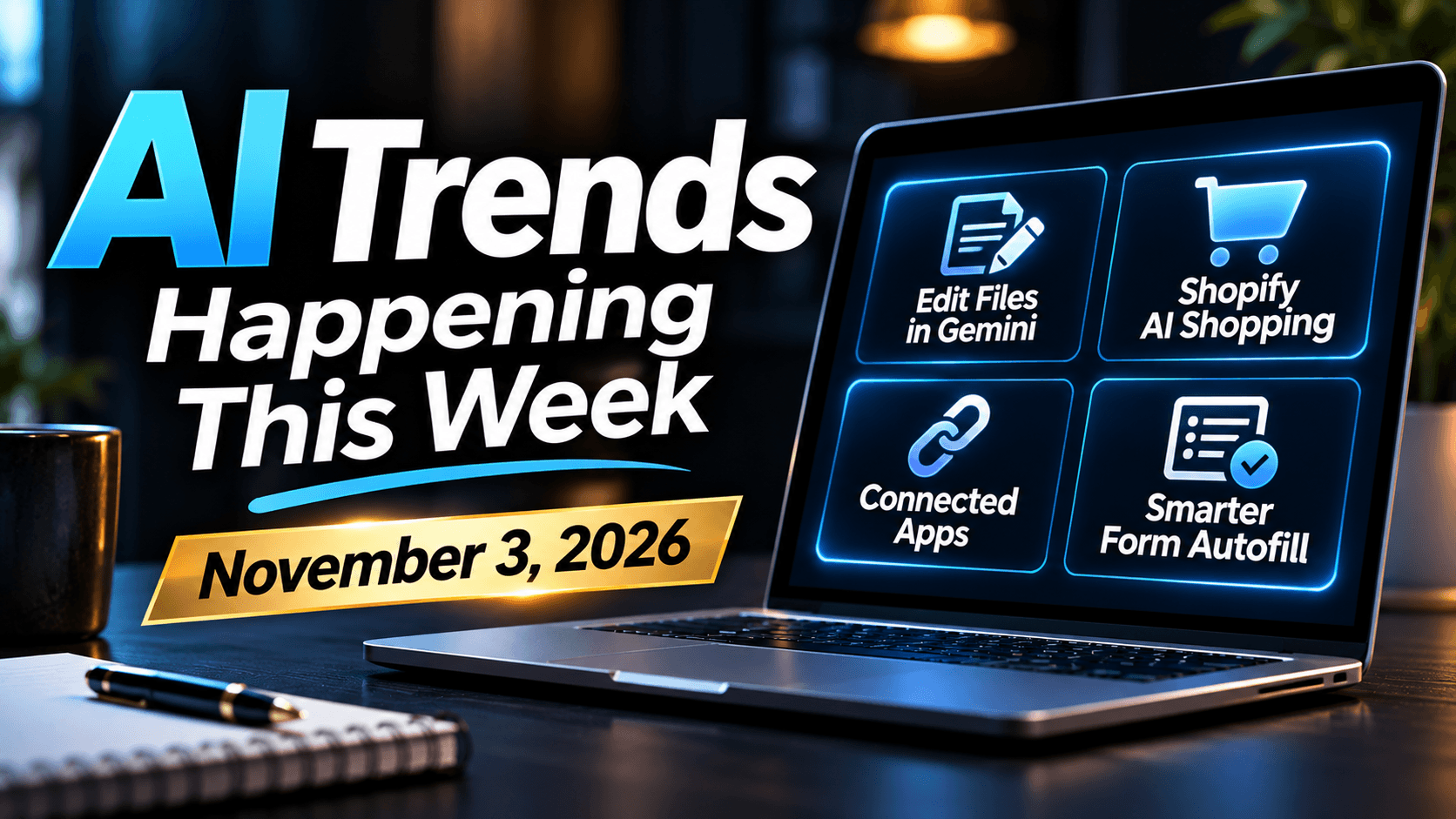
AI Trends Happening This Week: November 3, 2026
Gemini file editing, Shopify AI shopping, connected apps, and smarter Chrome autofill
Remember when getting something done meant opening one program, doing the work, and closing it?
This week's AI announcements offer an interesting alternative: instead of giving us another place to work, companies are trying to bring useful actions into the places we already spend our time.
From editing files in Gemini to shopping through AI assistants, these four updates show what that shift looks like. And yes, there are still a few fine-print details worth reading before you hand over the keys.
1. Google Brings Document and PDF Editing Directly Into Gemini
On October 29, Google announced that people can create, preview, and edit files inside the Gemini app, rather than moving every draft into a separate editor.
The supported work includes documents, PDFs, presentations, spreadsheets, text and Markdown files, and code. Within a Gemini chat, users can open a preview, expand it to full screen, make manual edits, highlight a section, or ask Gemini to revise particular text or visuals.
Picture an entrepreneur preparing a simple client proposal. They could draft the document, inspect it, adjust the wording, and refine a section without constantly bouncing between the chat and another application. A creator might work on a presentation outline or review a PDF handout the same way.
Google says PDF preview and editing work on web and mobile. The other supported file types are web-only for now. The company also says the capabilities are available in all languages and regions where the Gemini app is offered.
That's a meaningful difference from an announcement that's still on a waiting list. But available doesn't mean flawless. Formatting, calculations, citations, and important business details still deserve a careful look before anything goes to a client.
The small-business takeaway: Test the feature with a low-risk document you already need to create. If it reduces the back-and-forth without creating more corrections, that's a real improvement.
Google explains the new in-app file editing experience in its official announcement.
2. Shopify Makes It Easier for AI Agents to Find and Sell Products
Shopify's October 28 Fall '26 Edition focused partly on a new shopping habit: asking an AI assistant to help find something, compare options, and move toward checkout.
The company introduced Shop.md, a shopping skill that compatible AI agents can use to search Shopify's catalog, make recommendations, and support checkout through Shop Pay. Shopify says the catalog includes more than a billion products.
This is an example of agentic commerce. Instead of only answering, "Which hiking bag should I buy?", an AI assistant may help search products, narrow choices, build a cart, and support the purchase process. The shopper still needs to approve the transaction.
For a niche retailer, that could mean products becoming discoverable through a conversation rather than only through a traditional store search. Imagine someone asking an assistant for a practical gift under a certain budget, then receiving options from participating merchants.
Shopify also expanded connections that let merchants use supported AI assistants to work with store products, inventory, orders, and performance. Its merchant announcement lists nine compatible agents, including ChatGPT, Claude, Gemini, and Copilot.
Here's the distinction: Shopify had already opened parts of agentic commerce to developers earlier in 2026. The Fall release expands the tools and connections. It isn't the first moment AI shopping became possible.
Affiliate marketers should watch how discovery and attribution evolve, but shouldn't assume every AI-driven recommendation includes an affiliate commission or preserves a referral link.
The small-business takeaway: Keep product information, availability, pricing, and descriptions accurate. If AI assistants are going to help shoppers choose, unclear product data won't do your store any favors.
Read Shopify's Fall '26 merchant update and its developer announcement.
3. Google Expands Connected Apps Across Gemini and Search
On October 28, Google introduced a preview of its Connected Apps Platform, a system developers can use to build and manage integrations that work across the Gemini app and Google Search.
The difference is simple. Asking AI for advice might produce a checklist for a task. A connected app could potentially let AI take an authorized action in the service where the task belongs, depending on the integration and your permissions.
Google says developers can build an integration, test it, submit it for review, and choose whether it appears in Search, Gemini, or both. This is primarily a developer initiative, not a new dashboard every small business owner needs to set up.
Google also highlighted connected services. It says integrations including Adobe and Peloton are live for eligible Gemini users, while a Calm integration is planned. Availability differs across apps and products, and the platform itself is opening to developers in phases.
For entrepreneurs, the interesting possibility is less app-hopping. Think about researching an idea and then moving into a connected service to complete the next step, without rebuilding the context from scratch.
But connections require trust. Before granting access, check what information a service can read and what actions it can perform. Convenience should never mean surrendering control.
The small-business takeaway: Don't rush to connect everything. Watch for integrations that remove a specific repeated step from your workflow, and test those first.
Google outlines the Connected Apps Platform and rollout in its official announcement.
4. Chrome Uses Gemini to Help Fill Out Forms With Gmail Information
Let's end with something gloriously ordinary: filling out a form.
On October 28, Google announced that Chrome's enhanced autofill can suggest information from Gmail, using Gemini and Personal Intelligence. Examples include order numbers, package tracking details, and flight reservations.
Traditional autofill already helps with familiar details such as names and addresses. This update aims to surface less predictable information that may be buried in an email.
Imagine a small business owner checking on a shipment. Instead of searching Gmail, copying the tracking number, and returning to the form, an eligible user may see a relevant suggestion while completing the form.
Google says the feature is beginning to roll out in the United States across desktop, Android, and iOS for Gemini in Chrome users who have Personal Intelligence enabled. That does not mean every Chrome user can use it today.
Google also says sensitive information is encrypted and users can manage enhanced autofill and its access in Chrome settings. Even so, suggested details should be checked before submission, especially when they concern orders, travel, or customer-related work.
The small-business takeaway: The most useful AI feature might not be a grand automation. It might be one less interruption during a routine task.
See Google's explanation of Gmail-powered enhanced autofill.
The Bigger Picture: Fewer Detours, Better Work
There's a common thread running through these announcements. AI is becoming more useful when it can work with the files, stores, services, and information people already use.
The goal isn't to collect the most AI features. It's to remove unnecessary steps, keep important decisions in human hands, and make the customer experience easier.
One less tab, one less repeated task, one less confusing handoff. Those are the improvements worth paying attention to.
So here's a question: If AI could remove one annoying step from your business this week, which step would you choose? |

What Customer Questions Reveal About Your Business | SMS
Learn how repeated customer questions reveal problems in your business. Try a simple 20-minute audit to improve the customer experience without new tools.
How to Organize Browser Tabs With AI | Self Made Success
Learn how to organize browser tabs with AI, save useful research, spot duplicates, and protect unfinished work with a simple, safer workflow for business owners.
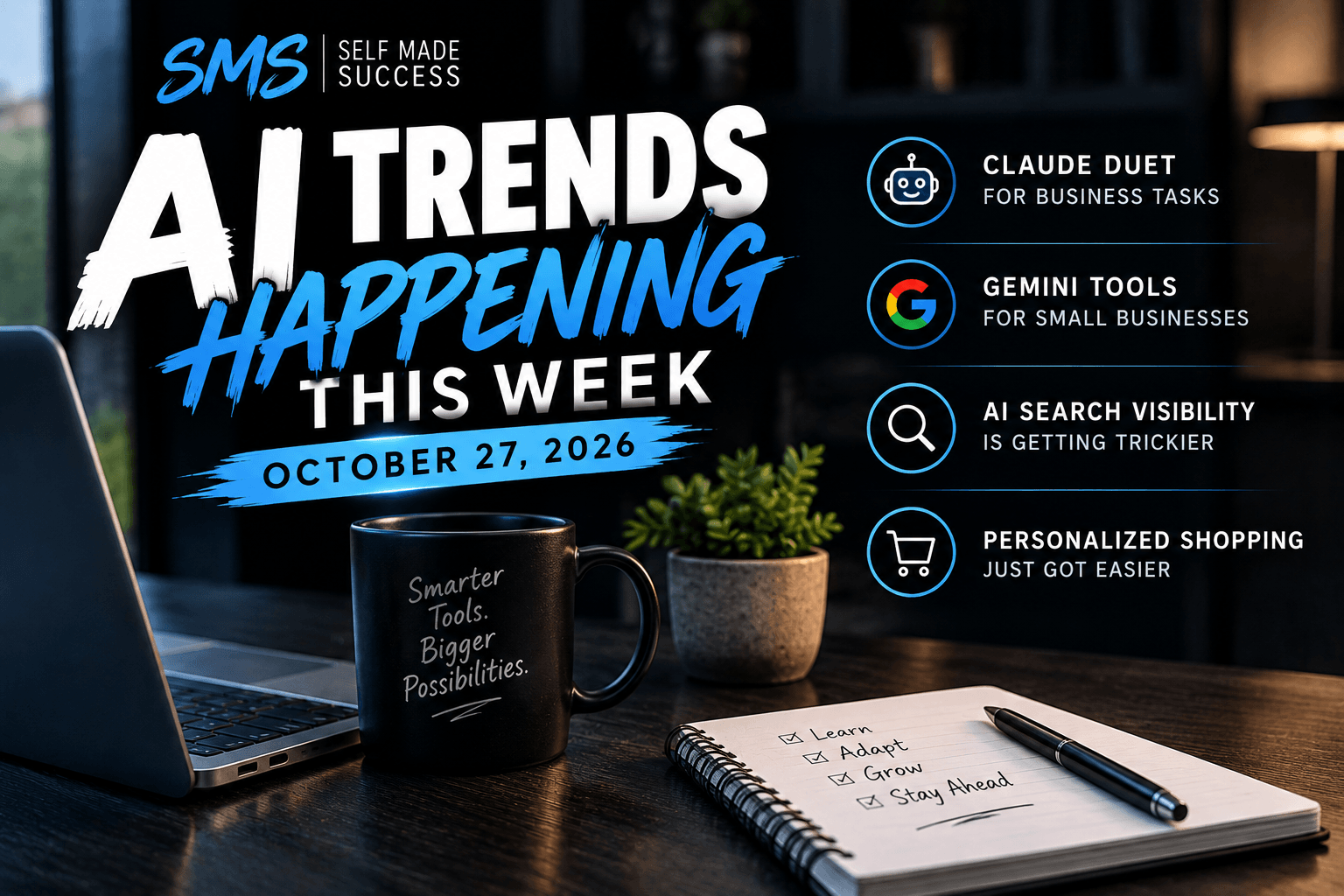
AI Trends October 27, 2026: Agents, Gemini, Search & Shopping
Explore four AI trends for entrepreneurs this week: Claude Duet, new Gemini business tools, changing AI search visibility, and smarter shopping quizzes.

5 Questions to Ask Before Adding Tools to Your Business
Before adding another business tool or strategy, use these five practical questions to save time, reduce clutter, and improve your customer experience.
0 Comments
Join the conversation
Be the first to comment
Share your thoughts above.